MADE in SC Research Area: Thrust 1
Ba3Fe1.56Ir1.44O9: A Polar Semiconducting Triple Perovskite with Near Room Temperature Magnetic Ordering
Timothy Ferreira, Darren Carone, Amanda Huon, Andreas Herklotz, Sebastian A. Stoian, Steve M. Heald, Mark D. Smith, Hans-Conrad zur Loye
In a centrosymmetric structure, each atom has a twin located on the other side of the center of the structure. This is what we find in most crystal structures. Only a select few structures are non-centrosymmetric, meaning that the twin is absent. Currently we believe that to create a multiferroic material, one has to find structures that are non-centrosymmetric and then attempt to make them magnetic. This has proven to be very difficult. Now, however, it seems that we may be able to convert, chemically, materials that are already magnetic and centrosymmetric (and more numerous) into structures that are magnetic and non-centrosymmetric. This may allow us to make multiferroic materials with which it is possible to turn on or off the magnetic behavior by applying a voltage across the material. These would be very versatile functional materials and would eventually make an appearance in everyday life.
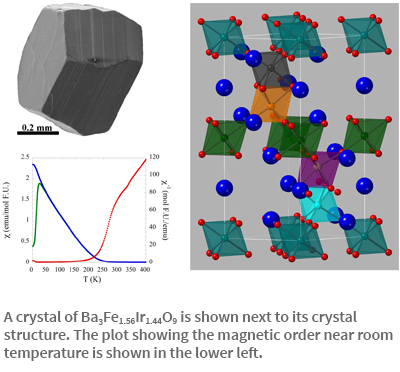
Non-centrosymmetric polar materials find applications as ferroelectric materials, as non-linear optics, as lasers and in telecommunication. Furthermore, the combination of a non-centrosymmetric polar structure with magnetic order can potentially lead to multiferroic behavior, an exceedingly rare phenomenon, currently limited by our ability to incorporate both behaviors into the same structure. This work suggests that many more structure types can potentially exhibit multiferroic behavior if the non-centrosymmetry and polarity can be compositionally introduced.
A polar, non-centrosymmetric iridate was prepared via site occupancy non-stoichiometry in an otherwise centrosymmetric, non-polar triple perovskite structure. Non-centrosymmetric polar structures are rare and this finding indicates that the ability to induce polarity in almost any structure via mixed cation site occupancy exists.
Return to Research Highlights Overview